
Trade Finance Infrastructure & Payroll Operations Automation Solutions
Client: GatiPay Technologies Private Limited
Platform Used: Zoho Payroll Application
Introduction
GatiPay is an innovative intelligence-led trade finance and MSME credit infrastructure platform designed to enable seamless capital flow across India's trade value chains (including Invoice Discounting, Working Capital Loans, Warehouse Financing, and Term Loans). To support its rapidly expanding workforce, multi-state corporate footprint, and cross-functional teams, GatiPay chose to modernize its salary processing and compensation workflows.
Moving away from manual spreadsheets and legacy payroll scripts, the brand partnered with automation specialists to deploy Zoho Payroll, a cloud-based payroll management platform, establishing a centralized, secure infrastructure to streamline wage computation, statutory compliance deductions, employee self-service tax declarations, and direct bank disbursals.
Problem Statement
Prior to implementing the custom automated cloud payroll solution on Zoho Payroll, GatiPay faced critical operational challenges across its financial and HR operations:
- Manual Salary Computation Risks: Heavy reliance on manual spreadsheets for calculating gross pay, loss-of-pay (LOP) deductions, allowances, and reimbursements created operational risks and computational errors.
- Complex Multi-State Statutory Compliance: Managing multi-state statutory rules manually (PF, ESI, Professional Tax, and Income Tax TDS) led to compliance overheads and potential regulatory risks.
- Opaque Tax Declaration & Reimbursement Process: Lack of a direct self-service portal for staff to submit tax-saving declarations (Section 80C/80D) and reimbursement proofs resulted in administrative delays and manual document processing.
- Disjointed Accounting & Direct Disbursal Flow: Manually exporting payroll files for banking payouts and re-keying ledger entries into the corporate accounting software created data reconciliation delays.
Objectives
The implementation of the custom Zoho Payroll application is guided by key business objectives:
- Transitioning payroll processing into an automated, error-free, and statutory-compliant cloud engine.
- Empowering employees with a dedicated self-service portal for viewing payslips, managing tax investments, and submitting reimbursement claims.
- Eliminating manual banking transfer friction via direct bank integration for instant salary disbursals and automated payout advisories.
- Ensuring absolute data privacy and Role-Based Access Control (RBAC) so only authorized finance and HR administrators manage sensitive salary structures.
Features of the Implemented System
Product & Services Portfolio (Core Architecture)
The custom modules deployed on the Zoho Payroll platform include:
- Salary Structure Builder & Component Master: Dynamic setup of basic pay, HRA, special allowances, variable pay, and custom reimbursement heads tailored to corporate compensation policies.
- Employee Self-Service (ESS) Payroll Portal: Centralized self-service portal for employees to download Form 16, access digital payslips, and manage tax declarations.
- Automated Statutory Compliance Engine: Pre-configured compliance tools for statutory deductions including Provident Fund (PF), Employee State Insurance (ESI), Professional Tax (PT), and TDS (IT).
- Direct Bank Disbursal Module: Native banking integrations enabling one-click bulk salary transfers and instant payment confirmations.
- Payroll Accounting & General Ledger Sync: Automated posting of payroll expenses and liabilities into core accounting ledgers.
Step-by-Step Core Workflow Logic
- Step 1 - Salary Structure & Employee Setup: New employee records are mapped with defined CTC structures, tax regimes (Old vs. New), and statutory rules.
- Step 2 - Investment Declaration & Verification: Employees submit IT investment declarations and proofs via the ESS portal; HR/Finance reviews and approves documents online.
- Step 3 - Attendance & LOP Sync: Monthly attendance records and Loss-Of-Pay (LOP) inputs are imported to calculate exact payable days automatically.
- Step 4 - Payroll Processing & Computation: The system automatically computes gross salaries, statutory deductions (PF, ESI, PT), and income tax TDS.
- Step 5 - Managerial Audit & Approval: Finance leadership reviews draft payroll reports, variance checks, and summary sheets before locking the payroll run.
- Step 6 - Direct Bank Disbursal: Locked payroll sends direct payout requests to connected banking accounts for automated salary credit.
- Step 7 - Payslip & Form 16 Distribution & Accounting Sync: Digital payslips are dispatched automatically to employee portals, while journal entries post to the corporate accounting system.
Privacy, Data Protection & Deployment Standards
- Role-Based Access Control (RBAC): Multi-tier security profiles restrict access to sensitive salary details, ensuring data visibility is strictly limited to authorized payroll administrators.
- Data Encryption & Cloud Security: Enterprise-grade cloud encryption protects all compensation structures, bank account details, and tax documentation.
- Automated Compliance & Audit Logs: System user IDs and timestamps permanently log all salary revisions, payroll locks, and statutory deduction changes.
Benefits Breakdown
| Benefit Category | Description |
| For Employees | • Instant online access to digital payslips, Form 16, and annual earnings summaries on web and mobile. • Simplified online submission of tax declarations and reimbursement claims with real-time status updates. |
| For Management & Finance | • Error-free, automated salary processing that reduces monthly payroll processing time from days to hours. • Automatic generation of statutory compliance filing files (PF ECR, ESI, PT, and Form 24Q TDS returns). |
| For Operations & Security | • Seamless direct bank disbursals eliminating manual payment advice preparation and banking errors. • Complete data privacy and compliance adherence via strict role-based access control and encrypted cloud storage. |
Challenges
- Multi-State Statutory Alignment: Configuring dynamic state-specific Professional Tax (PT) rules and ESI applicability across GatiPay's regional locations.
- Legacy Salary Data Migration: Securely migrating historical payroll records, YTD earnings, and tax proof approvals into Zoho Payroll.
- Tax Regime Transition Guidance: Setting up systems to handle employee transitions between Old and New Income Tax Regimes seamlessly.
- Bank Integration Setup: Aligning automated banking host-to-host API authorizations for one-click payout executions.
Future Scope
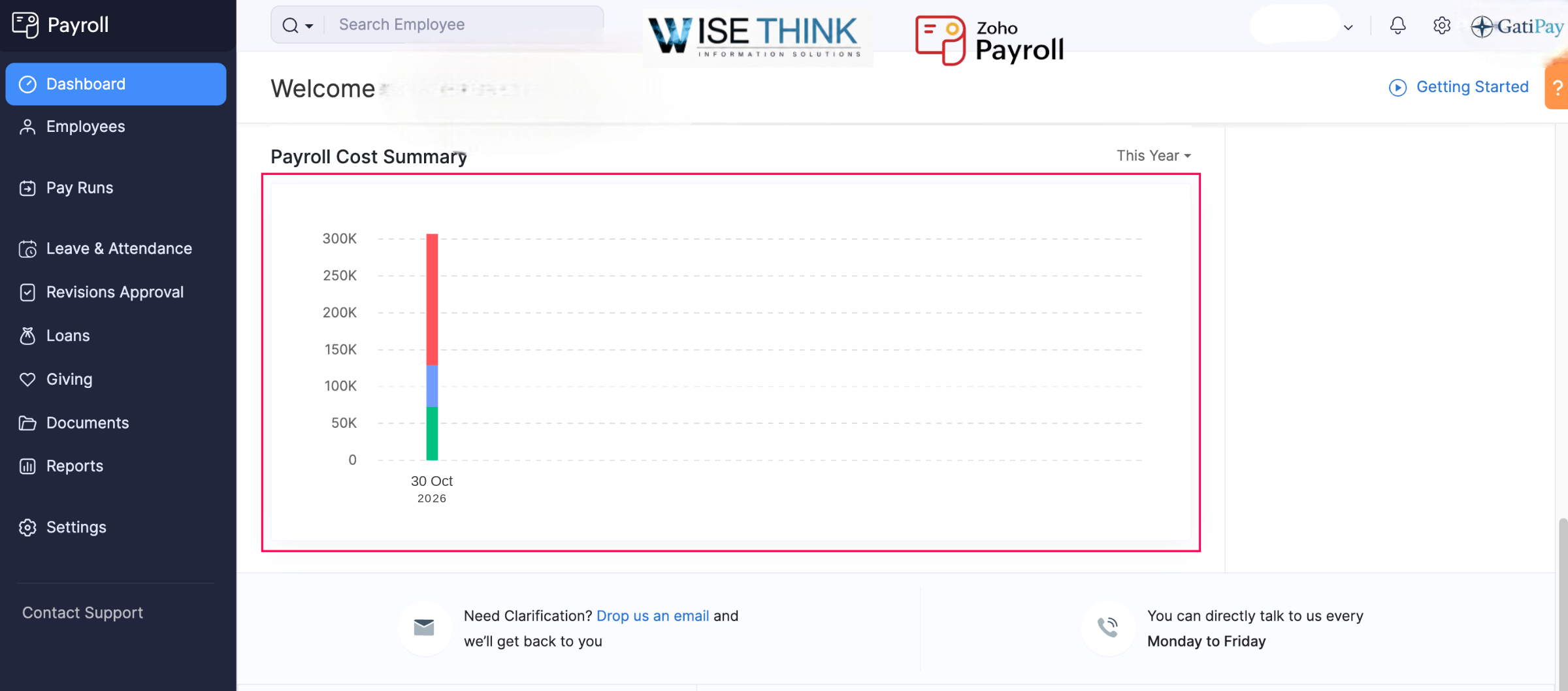
- Advanced Compensation Analytics: Implementing dashboards to analyze departmental payroll costs, salary trends, and statutory budget projections.
- Automated Variable Pay & Bonus Engine: Integrating performance-linked incentive models directly into monthly payroll processing.
- AI-Driven Tax Optimization Assistant: Deploying virtual guidance tools within the ESS portal to help employees optimize tax investments.
- Cross-Platform ERP Ledger Sync: Deepening automated API connections with core banking and enterprise accounting software for instant expense posting.
Conclusion
By deploying Zoho Payroll, GatiPay Technologies effectively modernizes its compensation management and financial operations workflows. Eliminating manual calculation risks and paper-based tax processes while establishing automated statutory compliance, direct bank payouts, and employee self-service empowers the organization with speed, total accuracy, and regulatory governance. This technological deployment creates a robust, scalable corporate infrastructure aligned with GatiPay's trade finance vision.